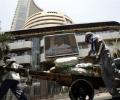
Over the past week, BSE Sensex fell sharply by 701.24 points to 27,366.07

Higher valuation creation in companies beyond the top 100 has given the domestic markets a shot at a $4 trillion market capitalisation (mcap) - a club exclusive to three countries currently. On November 23, the mcap of all BSE-listed stocks finished at a new record of Rs 328.33 trillion ($3.94 trillion), despite the benchmark indices ending with losses. The mcap was propelled by gains in the broader market, including small and midcap stocks - a trend dominant this year.

IndusInd Bank was the top loser in the Sensex pack, shedding around 2 per cent, followed by Titan, Tata Steel, M&M, Bajaj Finance and SBI. On the other hand, Bharti Airtel, HCL Tech, Tech Mahindra and Kotak Bank were among the gainers. NSE Nifty inched 8.95 points lower to 16,249.85 in early trade.

Among other stocks, IT firm Mphasis today reported a 15.30% increase in consolidated net profit at Rs 184.72 crore for the quarter ended September 30, 2015.

The trend in corporate earnings suggests that index earnings could fall to the levels last seen in early 2014.

'Historically, the markets tend to perform well during election years as governments aim to increase spending and call attention to growth.'

Companies, which missed out on listing earlier, are giving it another shot but with significantly-reduced issue sizes. In the recent past, companies such as TVS Supply Chain Solutions, Suraj Estate Developers, and ESAF Small Finance Bank have re-filed their draft red herring prospectuses (DRHPs) with the Securities and Exchange Board of India (Sebi). This came after they slashed their issue sizes by 20-60 per cent.

The markets closed in the positive terrain after witnessing choppy session during the day. The Sensex closed at 11,572.20 up 40 points.

All nine Adani stocks saw a rise in their share price in H1FY23, ranging from 6.1% in case of Adani Ports to 102% in case of Adani Power.

Top gainers in the Sensex pack included Bharti Airtel, Tata Motors, IndusInd Bank, Kotak Bank, Hero MotoCorp, Asian Paints and PowerGrid, which rose up to 2.53 per cent.

The board of Religare Enterprises Ltd (REL) has rallied behind its embattled chairperson Rashmi Saluja, saying she had turned around the financial services company whose market cap has increased to about a billion dollars from under $100 million in March 2018. The board -- which is fending off an Rs 2,200 crore open offer by the Burman family -- said accusations had not only targeted Saluja but the entire Religare management that has made Religare debt free. "Our story has been one of resurgence under the guidance of the Board of Directors led by Saluja, executive chairman.

The sharp jump in shares of Kalyan Jewellers (Kalyan) has surprised many on the Street; however, analysts believe more steam could be left in the stock as the Thrissur-based gold retailer pivots to a new asset-light network expansion model. Kalyan's stock has surged 62 per cent in the past month, even as the S&P BSE SmallCap Index has gained just 5 per cent. In its latest business update, the company said its consolidated sales grew more than consensus expectations at 31 per cent year-on-year, led by strong domestic sales regardless of the volatility in gold prices.

After disappointing guidances in the first quarter (Apr-Jun) of the 2023-24 financial year (Q1FY24) and valuation downgrades, the Indian IT sector could see some positive repricing as the bad news for IT maybe easing in Q2FY24. A key negative factor was weaker demand from the US financial sector and from North America in general. The latest GDP (gross domestic product) estimates and sector-specific news suggest that the demand situation may not be quite so bad with a gradual recovery in tech spending in Q2.

The benchmark Sensex is 2.4 per cent shy of a new lifetime high but the market capitalisation (m-cap) of all companies listed on the BSE is already in the record books. At Thursday's (August 18) closing price, the total m-cap of 4,776 firms on the BSE stood at Rs 280.5 trillion, surpassing the previous high of Rs 280 trillion on January 17. This, even if the Nifty Midcap 100 is currently 5.4 per cent below its lifetime high, while the Nifty Smallcap 100 index is down over 20 per cent.

Analysts remain selective on cement stocks amid the likely government's capex push ahead of the scheduled general elections in May 2024. While UBS has initiated coverage on the Indian cement sector with an anti-consensus negative view and suggests investors sell select cement stocks on a rally, those at Nomura remain selectively bullish on the sector and prefer companies with large brownfield optionality and multi-region presence. In the near-term, UBS expects strong earnings of cement companies in the next two quarters to be driven by robust demand and margin tailwinds, but suggests any sharp uptick in stock prices could offer a good opportunity for booking profits in the related counters.

Seifert smashed six sixes in his 43-ball blitz as New Zealand romped home

Lower crude oil costs and higher marketing margins are expected to raise the fortunes of oil marketing companies (OMCs) in the first quarter (Q1) of 2023-24 (FY24), while city gas distribution (CGD) companies could also benefit from lower spot prices of liquefied natural gas (LNG). However, in a break from the past, growth trends are expected to diverge for various segments within the broad energy sector. Analysts expect the earnings from gas production to go down for upstream national oil and gas companies such as Oil and Natural Gas Corporation (ONGC) and Oil India (OIL) due to the introduction of the new domestic gas pricing regime on April 1. After showing steep losses over the first half of 2022-23 (FY23), the marketing margins of OMCs have steadily recovered in four months.

'India has always been a bottom-up stock-picking market, and as growth recovers with higher liquidity, mid and small-caps always tend to outperform.'

The benchmark Nifty50 managed to reclaim its 200-day moving average (DMA) on Wednesday but about half of top 500 stocks continue to languish below this key technical indicator. The 200-DMA - nearly a year's average of closing prices - is analysed by traders to understand the market sentiment. A fall below these levels indicates a weak trend.

Riding on a strong stock market rally, Anil Ambani-led diversified business conglomerate Reliance Group has crossed Rs one lakh crore market valuation.

The stocks of Mumbai-based real estate companies have been hitting lifetime highs on expectations that launches, steady demand, and price increases in the largest real estate market in the country would boost their financials. Macrotech Developers (Lodha) and Oberoi Realty hit their all-time highs last week, while Godrej Properties came close to its 52-week high last month before witnessing a sharp correction.

Even as most of its large-cap pharmaceutical peers have struggled to stay above water on the returns front, Zydus Lifesciences has been one of the big outperformers within the sector over the past year with a return of over 30 per cent. The gains have come on the back of multiple triggers such as the scaling up of new product launches in the US market, clearance for its Moraiya (Gujarat) facility and steady performance in the domestic market. Though it has been the top pharma gainer in the 2022-23 financial year (FY23), brokerages continue to maintain their 'buy' stance, given the strong visibility in the US market.
The rumour verification process would now be triggered by changes in price or 'material price movements', as the paper defines it. What this means is that companies would need to verify rumours only if the share price moves significantly.

H S Prannoy lost a three-game thriller to China's Weng Hong Yang in the men's singles final.
.jpg)
ITC, TCS and HDFC Bank emerged as the biggest gainers during the period.

The Supreme Court Thursday asked NDTV promoters Prannoy Roy and Radhika Roy to give a statement on shares indicating the current market value which they would like to deposit as security with market regulator Sebi under the order of the Securities Appellate Tribunal (SAT).

Indian equity markets have a limited upside potential in the near-term as they negotiate the ensuing cyclical slowdown, wrote analysts at Nomura in a recent coauthored report led by Saion Mukherjee, their managing director and head of equity research for India. He, however, believes that the foundations are in place for sustainable growth over the medium-to-long term, and hence suggests a 'buy on dips' strategy to equity investors. As an investment strategy, Nomura prefers domestic-oriented sectors and companies over exporters, and prefers stocks that provide valuation comfort. Industrials and banks are their overweight sectors, while IT services and consumer discretionary are their underweight sectors.

'Rhetoric and chest-thumping are running high on India's recent growth record.'
'But will the giant waves developing elsewhere allow us to sail smoothly into fair winds?' asks Debashis Basu.

Tata Steel was the day's worst performer in the Sensex pack, plunging 3.25 per cent, followed by Bharti Airtel at 3.05 per cent.

Shares of Zomato on Friday zoomed nearly 53 per cent in its debut trade against its issue price of Rs 76. The stock made its debut at Rs 115, reflecting a huge gain of 51.31 per cent against the issue price on the BSE. It then hit a high of Rs 138, a jump of 81.57 per cent.

An aggressive rate hike by the US Fed and the possibility of a recession can trigger a slide in these stocks, which will be a good opportunity to buy from a long-term perspective.

Investors have gained Rs 3,93,349.08 crore in four days following a strong rally in the equity markets amid a declining trend in COVID-19 cases. In four consecutive sessions of gains, the 30-share BSE Sensex has climbed 1,299.91 points or 2.56 per cent. The BSE benchmark index on Monday closed at 51,937.44, a gain of 514.56 points or 1 per cent. In four days, the market capitalisation of BSE-listed companies zoomed Rs 3,93,349.08 crore to close at a record high of Rs 2,22,99,810.27 crore on Monday.

The 50-share NSE Nifty ended up 37.05 points, or 0.36 per cent, at 10,397.45 points

rediffGURU Ulhas Joshi recommends five factors you need to look at to evaluate the performance of two schemes.

The World Cup opener is set to be another barnstorming meeting between two of the favourites -- and a fitting way to start a cricketing feast.

Modi launched a scathing attack on the Congress alleging that the opposition party has become outdated and has always been against any kind of reservation.
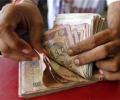
The rupee had surged 37 paise to end at a nine-month high of 59.68 against the dollar on Tuesday. Forex market remained closed on Wednesday for 'Buddha Purnima'.

The S&P BSE Auto Index has been one of the biggest outperformers among sectoral indices over the past year with returns of 26 per cent. By comparison, the benchmarks - the National Stock Exchange Nifty50 and the S&P BSE Sensex - managed about 6-8 per cent during this period. Improving demand, falling raw material costs, and rising product realisations, led by the premiumisation of portfolios, have led to a revision of growth estimates and upgrades by domestic brokerages.

The share of public sector undertakings (PSUs) in the total market capitalisation of listed companies--at an all-time low of 10 per cent currently --- may get a leg-up from the government's divestment push. Recently the government announced the successful sale of national carrier Air India to Tata Sons, India's first privatisation of a PSU since 2002-03. The transaction is expected to be completed by December.
